Publication date and last updated: 6 October 2026
October is Breast Cancer Awareness Month. Screening ages and intervals differ between countries. Follow the official programme where you live and discuss your personal risk with a healthcare professional. If you notice a new breast change or have a higher-than-average risk, do not wait for a routine screening date; arrange an individual assessment. [9]
Awareness is intended to help people recognise unusual changes, seek care at the right time and understand both the benefits and limits of screening. This article provides general information for adults at average risk; discuss personal risk and screening plans with an appropriate healthcare professional.
Why does breast cancer awareness matter?
Breast cancer accounts for an important part of the global cancer burden. [1]
IARC GLOBOCAN estimates for 2024 reported 2,434,087 new breast cancer cases and 693,660 breast cancer deaths worldwide. These modelled global estimates do not predict one person's risk or outcome. Age distribution, access to screening, registration systems and treatment options differ between countries. The figures show why breast health is an important public health issue, not a reason for personal fear. [10]
Awareness activities may improve knowledge and recognition of symptoms, but exposure to a campaign is not a diagnosis or treatment. Effective awareness should guide people towards evidence-based information and healthcare when needed. [5]
Which factors may increase breast cancer risk?
Breast cancer usually cannot be explained by one cause. Having a risk factor does not mean cancer will develop, and having no known risk factor does not mean zero risk. Many people diagnosed with breast cancer have no known family history. [11]
- Age and biological sex: Breast cancer is more common in women and risk increases with age; it can also develop in men. [11]
- Family history and genetic susceptibility: Breast or ovarian cancer at a young age in close relatives and pathogenic variants in genes such as BRCA1/BRCA2 may increase risk. Family history helps determine through individual assessment whether genetic testing may be appropriate. [11]
- Personal medical history: Previous breast cancer, some high-risk breast lesions and chest radiotherapy at a young age are relevant. [11]
- Hormonal and reproductive factors: Some features related to lifetime hormonal exposure may be associated with risk, but do not predict an outcome on their own. [11]
- Modifiable factors: Alcohol consumption, higher weight after menopause, physical inactivity and some hormone therapies are associated with risk. Healthy habits may help reduce risk, but cannot guarantee prevention. [2]
- Age
- Family history or genetic susceptibility
- Personal history or chest radiotherapy
- Hormonal and reproductive history
- Alcohol consumption
- Higher weight after menopause
- Physical inactivity
- Some hormone therapies
Risk is not certainty: Having one of these factors does not mean breast cancer will develop. Having no known factor does not reduce risk to zero. Do not change hormone therapy without medical advice.
Which new breast changes should be assessed?
Seek medical advice if any of the following is new:
- A new lump or thickening in the breast or armpit
- A new change in the size or shape of one breast
- Dimpling, tethering or an orange-peel-like skin appearance
- A newly inverted nipple
- Spontaneous bloody or clear nipple discharge
- A new lump in the armpit
Many of these changes can also have causes other than cancer. They should still be assessed. A new symptom calls for diagnostic assessment rather than waiting for a routine screening appointment. [11]
Screening or diagnostic assessment?
Follow the official screening programme where you live; age and interval vary by country
Arrange diagnostic assessment without waiting for a routine screening date
Screening and follow-up planned according to individual risk
This schematic simplifies the general pathway. It does not show anatomy or make a diagnosis, and it does not replace personal medical assessment.
What are the benefits and limits of mammography?
Mammography is a screening method intended to detect some breast cancers earlier in people without symptoms. Screening does not prevent cancer and cannot detect every cancer. Systematic reviews show that possible benefit for breast cancer mortality varies with age, risk level, screening interval and study methods. [3]
A screening result can be suspicious even when cancer is absent. Further mammography, ultrasound, MRI or biopsy may be needed. Screening can involve false positives, anxiety, additional procedures and overdiagnosis. Benefits and possible harms should be discussed in the context of age, personal risk and the official programme where you live. [4]
How can breast self-awareness be practised?
Guidance commonly supports becoming familiar with the usual appearance and feel of your breasts, checking about once a month if helpful, and reporting any new change. Self-examination alone is not a substitute for the official screening programme where you live or for clinical assessment. [12] [13] [14]
You may check approximately once a month at a suitable time. If you menstruate, choosing a similar point in each cycle may make comparison easier. Knowing what is usual for you matters more than following a rigid technique. This does not replace mammography, clinical assessment or diagnosis.
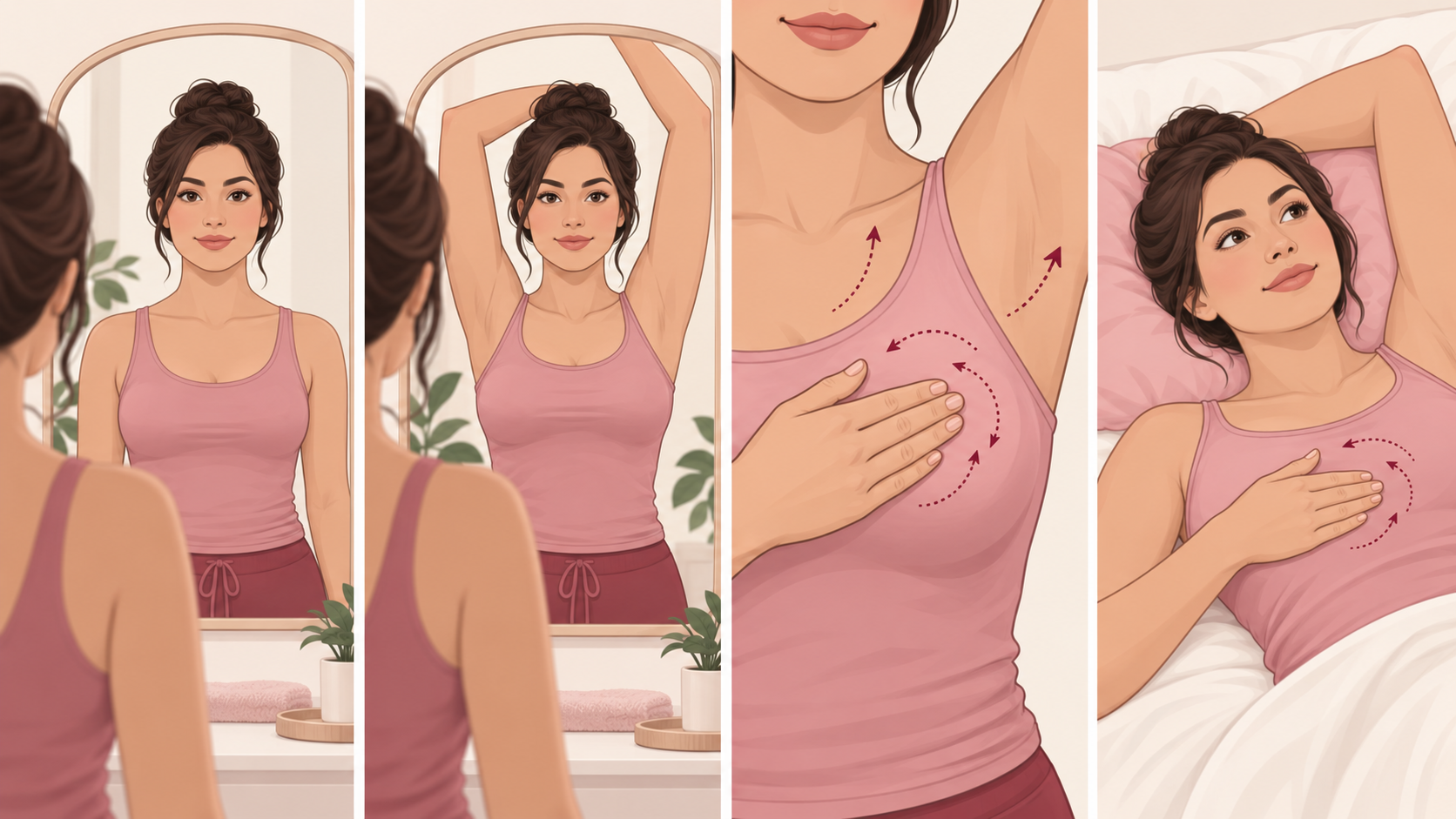
- Look in a mirror: Observe your breasts first with your arms down and then raised. Look for a new change in shape, skin dimpling or a nipple change.
- Check gently: Keep your fingers flat and together. Use small circular movements to check the whole breast, armpit and area towards the collarbone; do not press hard enough to hurt.
- Choose a method that feels comfortable: You may check in the shower or standing, and complete it lying down if you wish.
- Take a new change seriously: If you notice an unusual change, do not try to diagnose yourself; contact a healthcare service.
Treatment after diagnosis and the role of a plastic surgeon
After a breast cancer diagnosis, the plan is developed by relevant disciplines, which may include breast surgery, medical oncology, radiation oncology, radiology, pathology and, when appropriate, plastic and reconstructive surgery. Treating the cancer safely comes first.
Oncoplastic breast surgery, combines removal of cancerous tissue according to oncological principles with reshaping of the remaining breast or replacement of lost volume with other tissue. It aims to preserve or recreate breast shape without delaying cancer treatment. [6]
Breast reconstruction after mastectomy, may use an implant or the person's own tissue and may be performed at the same operation or later. Tumour features, tissue condition, radiotherapy or chemotherapy, general health, possible complications and preferences influence method and timing. Immediate and delayed reconstruction have different benefits and risks; there is no single option for everyone. [7] [8]
Joint assessment by the person and relevant specialties, with cancer treatment as the priority
Radiotherapy or chemotherapy plans, general health, tissue condition and personal preferences influence timing. Choosing no reconstruction is also an option after personal and medical assessment. There is no single right path.
Simple steps for this month
- Check your age, last screening date and known risk factors.
- Follow the official breast screening programme in the country where you live; screening age and interval differ between countries. [9]
- If you notice a new breast change, seek assessment rather than waiting for a routine screening date.
- If you have a close relative with breast or ovarian cancer, known genetic susceptibility or previous chest radiotherapy, discuss an individual plan with your clinician.
- Use official health information and verifiable scientific publications rather than alarming social media content.
References
- Bray F, Laversanne M, Sung H, Ferlay J, Siegel RL, Soerjomataram I, Jemal A. Global cancer statistics 2022: GLOBOCAN estimates of incidence and mortality worldwide for 36 cancers in 185 countries. CA: A Cancer Journal for Clinicians. 2024. DOI: 10.3322/caac.21834. PMID: 38572751. PubMed
- Poorolajal J, Heidarimoghis F, Karami M, Cheraghi Z, Gohari-Ensaf F, Shahbazi F, Zareie B, Ameri P, Sahraee F. Factors for the Primary Prevention of Breast Cancer: A Meta-Analysis of Prospective Cohort Studies. Journal of Research in Health Sciences. 2021. DOI: 10.34172/jrhs.2021.57. PMID: 34698654. PubMed
- Bennett A, Shaver N, Vyas N, Almoli F, Pap R, Douglas A, Kibret T, Skidmore B, Yaffe M, Wilkinson A, Seely JM, Little J, Moher D. Screening for breast cancer: a systematic review update to inform the Canadian Task Force on Preventive Health Care guideline. Systematic Reviews. 2024. DOI: 10.1186/s13643-024-02700-3. PMID: 39702409. PubMed
- Nelson HD, Pappas M, Cantor A, Griffin J, Daeges M, Humphrey L. Harms of Breast Cancer Screening: Systematic Review to Update the 2009 U.S. Preventive Services Task Force Recommendation. Annals of Internal Medicine. 2016. DOI: 10.7326/M15-0970. PMID: 26756737. PubMed
- O’Mahony M, Comber H, Fitzgerald T, Corrigan MA, Fitzgerald E, Grunfeld EA, Flynn MG, Hegarty J. Interventions for raising breast cancer awareness in women. Cochrane Database of Systematic Reviews. 2017. DOI: 10.1002/14651858.CD011396.pub2. PMID: 28185268. PubMed
- Wignarajah P, Malata CM, Benson JR. Oncoplastic and reconstructive breast surgery. Frontiers in Oncology. 2023. DOI: 10.3389/fonc.2023.1176915. PMID: 37448512. PubMed
- Matar DY, Wu M, Haug V, Orgill DP, Panayi AC. Surgical complications in immediate and delayed breast reconstruction: A systematic review and meta-analysis. Journal of Plastic, Reconstructive & Aesthetic Surgery. 2022. DOI: 10.1016/j.bjps.2022.08.029. PMID: 36202732. PubMed
- Tsantakis V, Dimitroulis DA, Kontzoglou KC, Nikiteas NI. Investigating the Difference in Quality of Life Between Immediate and Delayed Breast Cancer Reconstruction: A Systematic Review. Cancer Diagnosis & Prognosis. 2024. DOI: 10.21873/cdp.10312. PMID: 38707717. PubMed
- T.C. Sağlık Bakanlığı Halk Sağlığı Genel Müdürlüğü. Aile Hekimliği Kullanıcıları Eğitim Rehberi 2024 — Meme Kanseri Tarama Programı. 2024. Official guide (PDF)
- International Agency for Research on Cancer. Global Cancer Observatory: Breast fact sheet — GLOBOCAN 2024. 2026. IARC fact sheet (PDF)
- World Health Organization. Breast cancer — Fact sheet. 3 July 2026. WHO official information page
- NHS. How to check your breasts or chest. Last reviewed 19 July 2024. NHS official guide
- T.C. Sağlık Bakanlığı Burdur İl Sağlık Müdürlüğü. Meme Kanseri Farkındalık Ayı 1-31 Ekim. 1 October 2026. Official information
- American Cancer Society. American Cancer Society Recommendations for the Early Detection of Breast Cancer. Last Revised July 23, 2026. Current ACS recommendations
About the Author
Op. Dr. Yasemin Aydınlı, Hacettepe Üniversitesi İngilizce Tıp Fakültesi mezunudur; Plastik, Rekonstrüktif ve Estetik Cerrahi uzmanlık eğitimini Ankara Üniversitesi Tıp Fakültesi’nde tamamlamıştır. İstanbul’da estetik ve rekonstrüktif cerrahi alanında çalışmaktadır. Bu yazı, meme kanseri farkındalığı ve rekonstrüktif seçenekler hakkında genel bilgi vermek amacıyla hazırlanmıştır.
This content is for general information and does not replace examination, diagnosis or personal treatment advice. If you notice a new breast change, contact your family doctor or an appropriate healthcare service.